

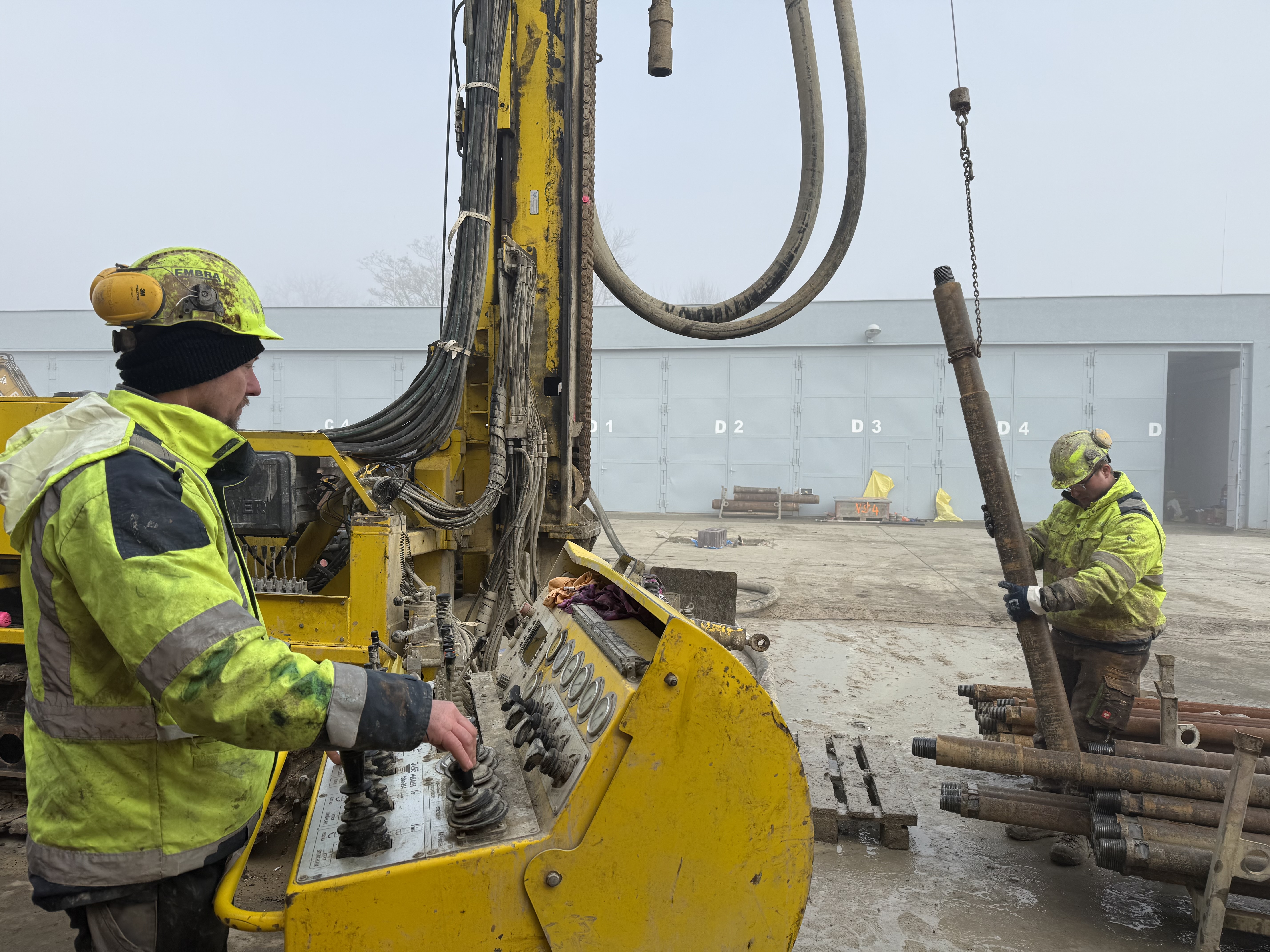
Temperature monitoring and thermal response tests are being conducted in the recently completed wells of the first BTES 1 drilling field. This field consists of four 100-meter-deep production wells and three monitoring wells of the same depth. Petr Dědeček, a geothermal scientist at the Institute of Geophysics of the Czech Academy of Sciences, is responsible for conducting the tests and analyzing the collected data. Standard methods for measuring temperature in wells often rely on point sensors, but this facility uses an optical cable that functions as a single continuous temperature sensor capable that measures temperature along its entire profile. In all seven boreholes of the BTES 1 drilling field, with a total depth of 700 meters, a loop of optical cable has been installed, reaching a length of 1,400 meters.“ Since the optical fiber itself does not achieve the same accuracy as laboratory measurements, the system is supplemented by three precise resistance sensors (so-called thermistors) in each well, located near the surface, at a depth of fifty meters, and at the bottom at a depth of one hundred meters, which allows for precise calibration of the entire profile,” explains Petr Dědeček.
An important part of the research is the Thermal Response Test (TRT), which is essential for the proper design of future underground thermal energy storage facilities. Using TRT, we are able to determine the effective thermal properties of the rock directly under real-world drilling conditions, and we can then compare these with laboratory measurements performed on drill cores. In Litoměřice, we plan to use two different TRT methods.
“The first is a standard water TRT, in which heated water is injected into the borehole and the flow rate and temperature difference at the inlet and outlet are monitored. The second, experimental method involves the use of an electric heating cable. This option allows us to heat the borehole at a constant or regularly varying power level for any length of time, even several weeks. This will enable us to monitor the reaction in the wider vicinity of the borehole using the aforementioned optical fibers,” adds Petr Dědeček.
The goal of these experiments is not merely to measure the thermal properties of rocks, but also to gain a deeper understanding of groundwater dynamics around the wells. The researchers plan to heat the central production well and monitor the surrounding observation wells to see how long it takes for the heat wave to reach them. If water is flowing underground, the heat will be carried in a certain direction, resulting in a faster and more pronounced temperature response in the well located in the direction of flow. These findings are crucial for the proper design and sizing of the future large-scale BTES 2 and BTES 3 wellfields.
All the data collected could be used in the future to create visualizations and online applications that will essentially generate a semi-transparent 3D model of the subsurface of the former Jiří z Poděbrad barracks site. The public and experts would thus be able to observe how the borehole arrays charge and discharge over time and how heat actually behaves within the rock mass.
