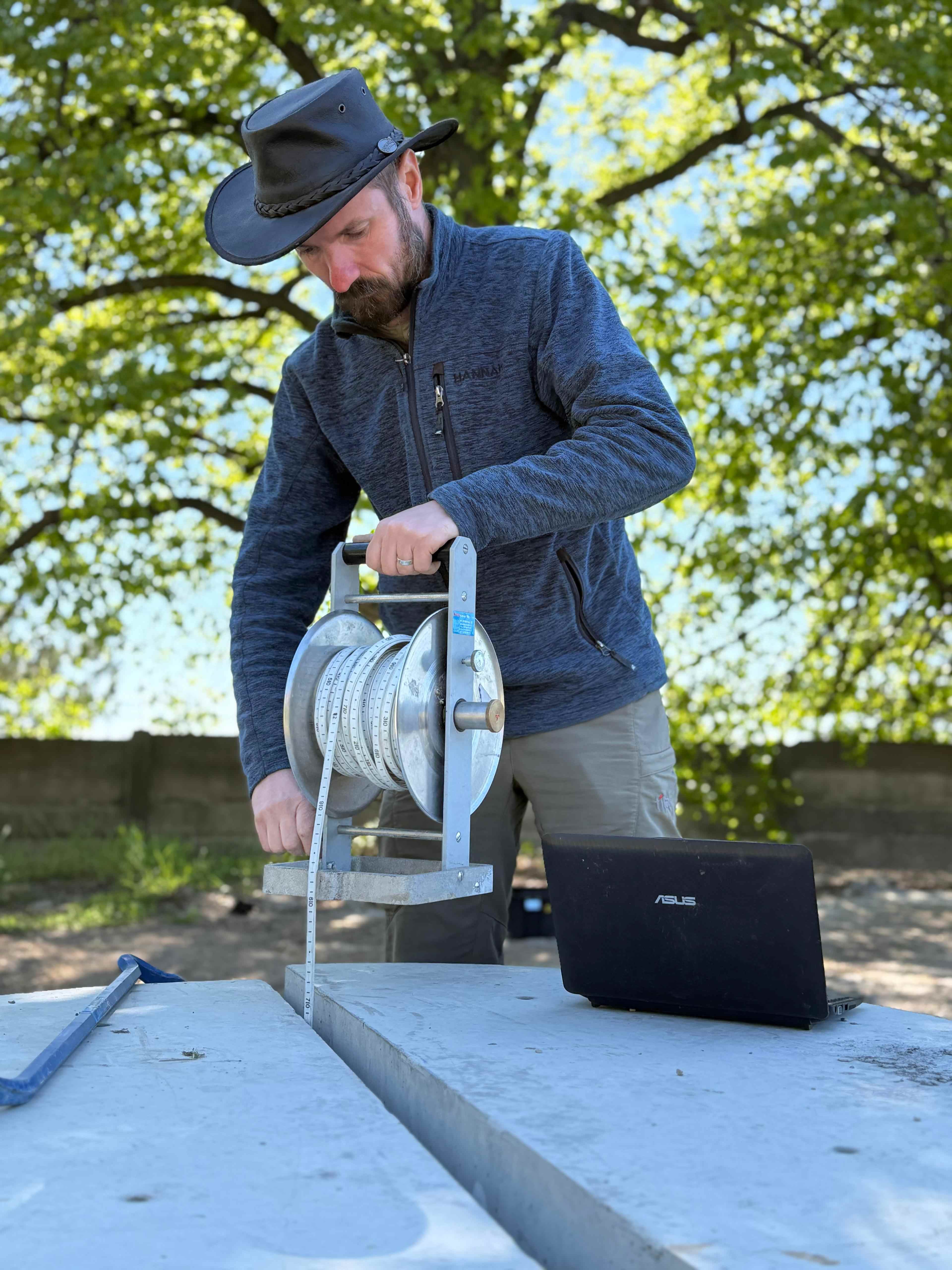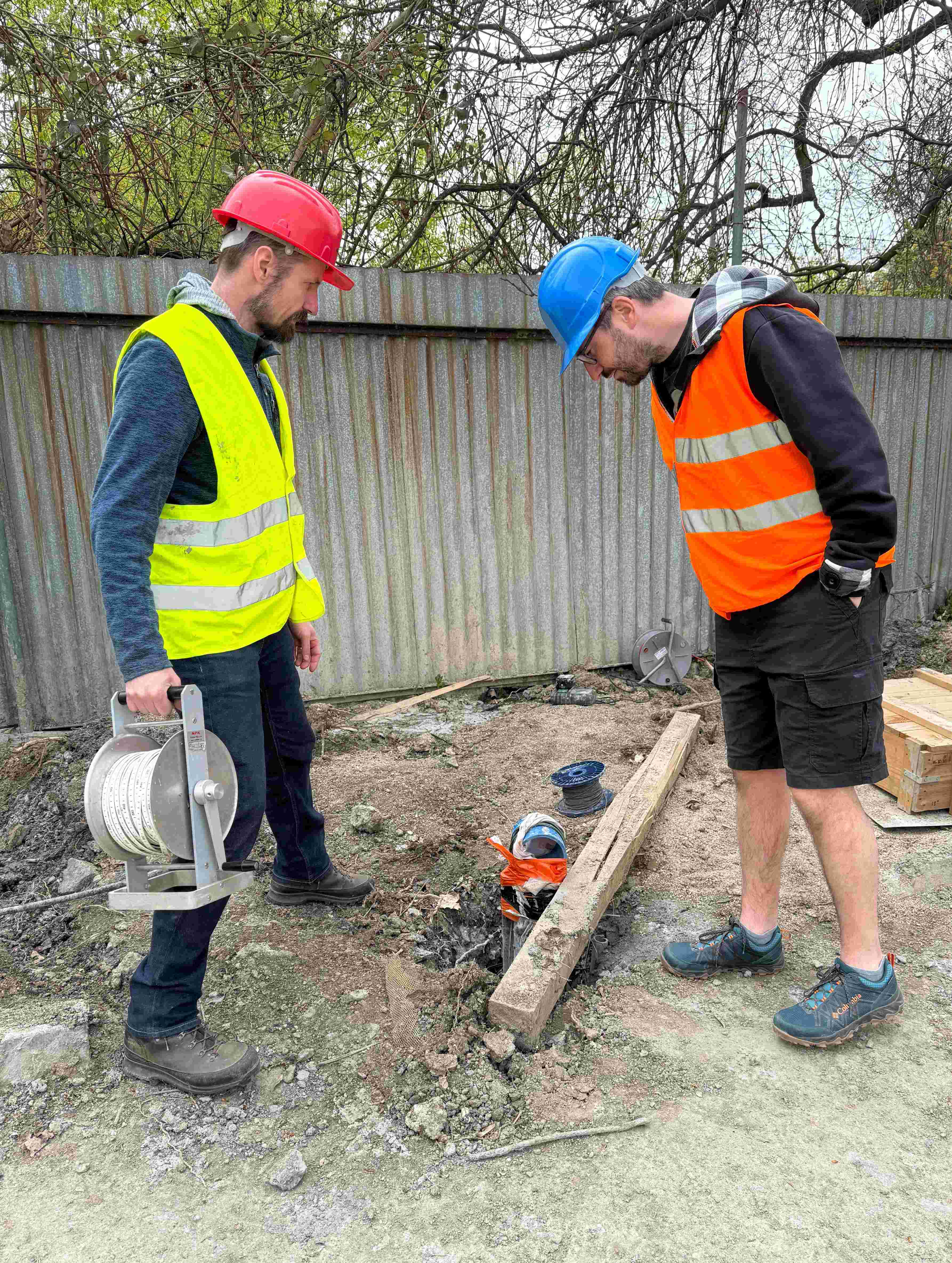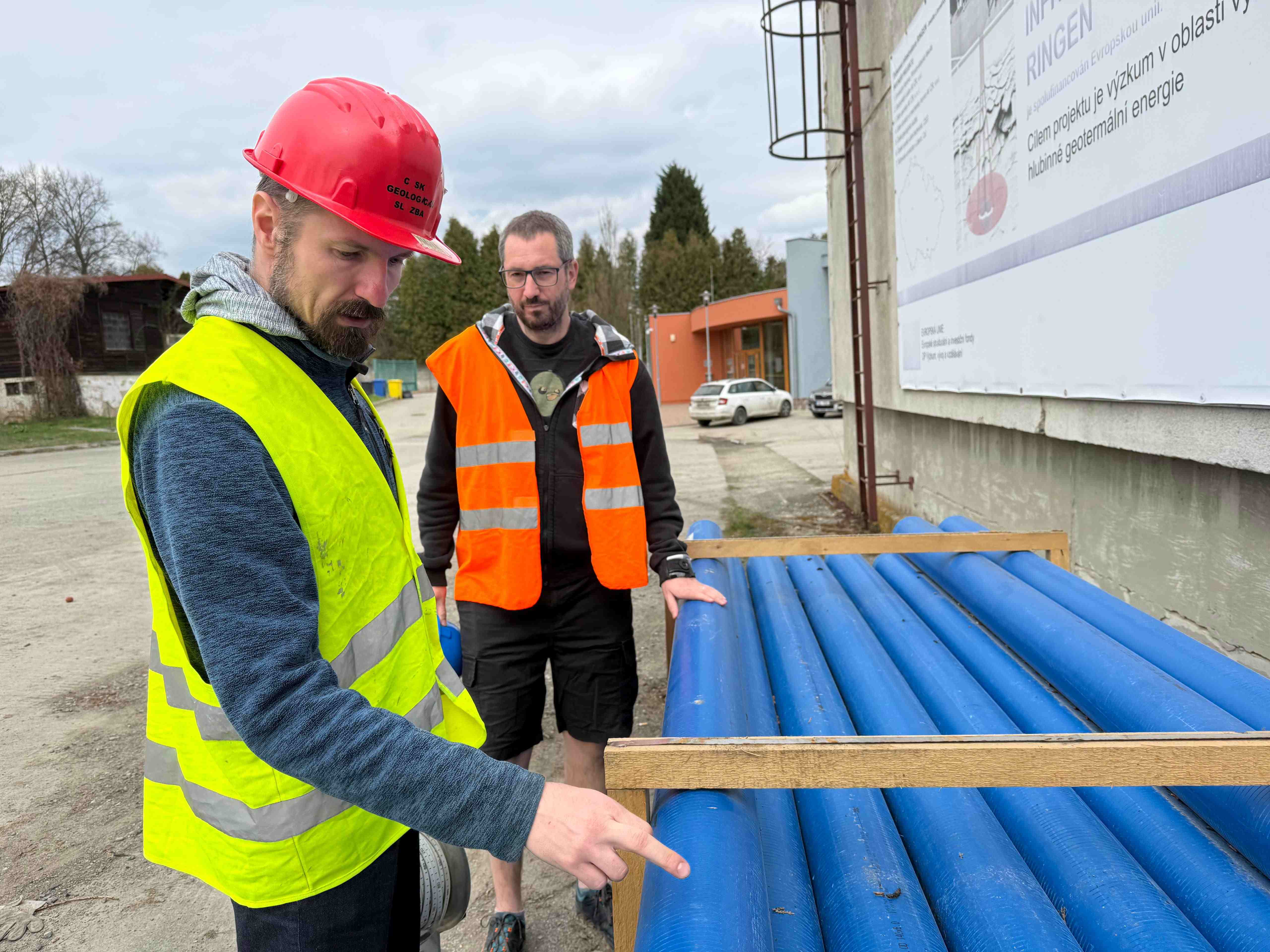

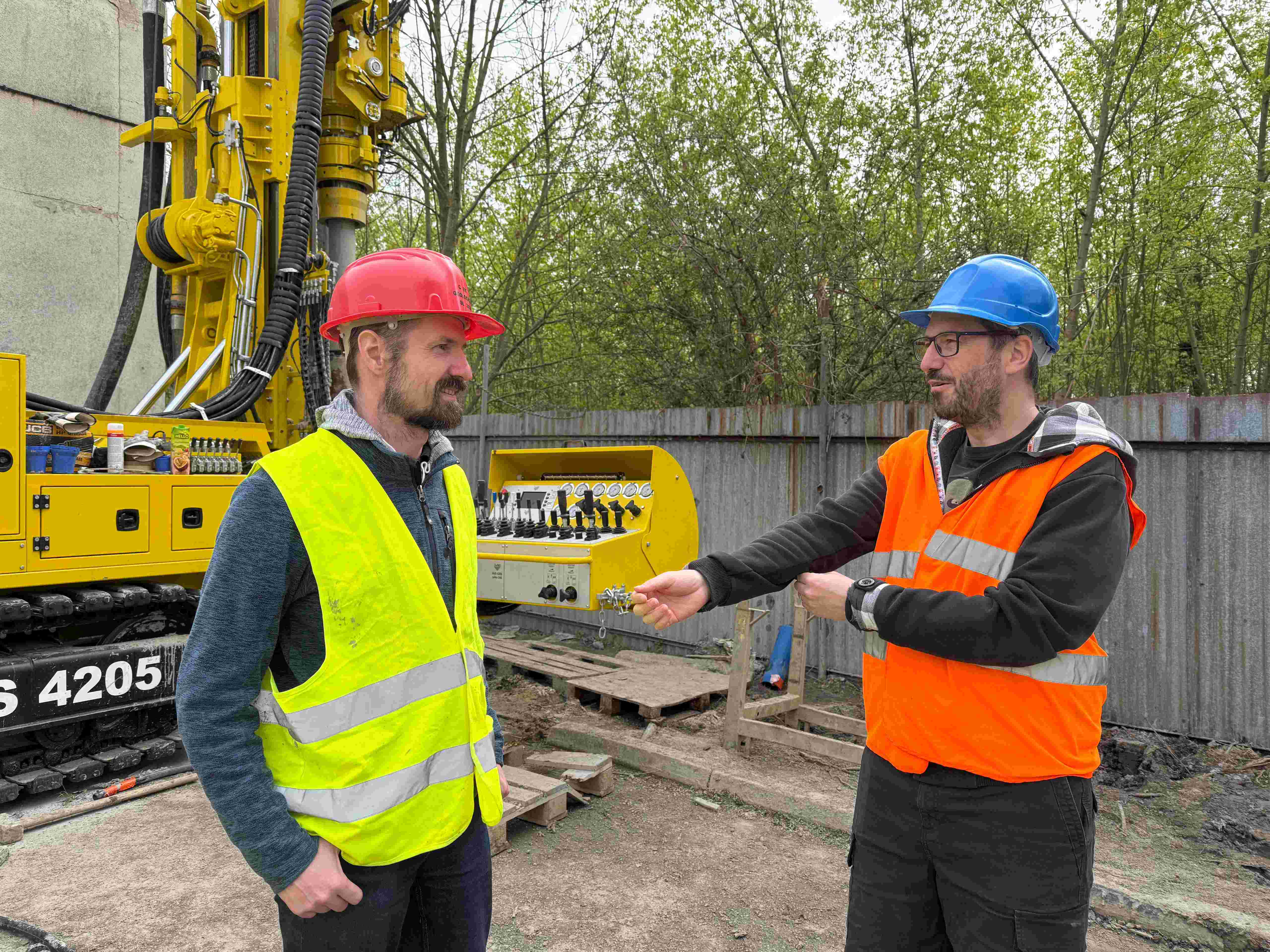
This model will be essential for the design of the future BTES2 and BTES3 storage fields, as well as for assessing the possible transport of heat within the rock environment. This part of the research is regarded as crucial to understanding whether, and to what extent, groundwater flow may affect the efficiency of seasonal heat storage. We discussed the subject with Jaroslav Řihošek, hydrogeologist at the Czech Geological Survey, and Josef Vlček, geophysicist.
Three pairs of hydrogeological monitoring boreholes, reaching depths of 100 and 200 metres, are planned at the RINGEN site. What stage have you reached, and where are the boreholes located?
J. Řihošek: At present, we are roughly halfway through the work. Three boreholes have already been drilled. The three pairs of boreholes within the RINGEN research infrastructure have been designed so that we can monitor two aquifer layers, specifically the Turonian and Cenomanian collectors, and at the same time gain a better understanding of how these two hydrogeological collectors are interconnected. This interconnection is of fundamental importance for the next stages of the research.
Why have these boreholes been arranged in a triangular configuration?
J. Řihošek: Each pair consists of one borehole drilled to a depth of 100 metres and another to a depth of 200 metres, located immediately next to one another. Arranging three such pairs in a triangular pattern allows us to determine the direction of groundwater flow. We work on the basis that the groundwater level surface is inclined in the direction of flow. If we measure water levels at three points, we can calculate the inclination of this surface and thereby determine the flow direction. Because we are monitoring two partially interconnected aquifers, we need to carry out this calculation separately for each of them. It is entirely possible that each will have a different flow direction and flow velocity.
What do you already know about the two aquifers?
J. Řihošek: At this stage, we know that the static groundwater levels at the site are approximately 22 metres below ground level. At the same time, it is becoming clear that there is a small but distinct hydraulic difference between the two aquifers. In the borehole reaching the Cenomanian collector, we measured the water level at approximately 20 centimetres lower than in the Turonian collector. This suggests that there is a weak vertical gradient between the two collectors and that water from the Turonian aquifer tends to flow slowly downward into the Cenomanian aquifer. The two collectors are separated by a semi-confining layer rather than by a completely impermeable barrier.
Why is it so important for heat storage to know the direction and velocity of groundwater flow?
J. Řihošek: Because groundwater can transport heat. If heat is stored in the rock environment while more pronounced groundwater flow is taking place, heat may be carried beyond the intended volume of the rock mass. For the design of the storage fields, we therefore need to know not only the direction of groundwater flow, but also how fast it moves. These data are essential for refining the hydrogeological model, which then serves as the basis for predicting heat transport and for designing the geometry of future storage fields, including their depth, borehole spacing, overall shape and orientation with respect to the direction of groundwater flow.
How will you determine the direction and velocity of flow in the boreholes?
J. Řihošek: We infer the flow direction from the groundwater levels measured in the individual boreholes, in other words from the geometry of the groundwater surface in both aquifers. We are trying to determine flow velocity by means of tracer-based and physical methods. One of these methods involves salinising the borehole and subsequently monitoring changes in electrical conductivity. In this way, it is possible to identify the depth intervals where inflow occurs and to determine how intensively water is flowing through them. We intend to carry out these measurements in all six hydrogeological boreholes. The result will be more precise information about which parts of the collectors are actively flushed and what the flow dynamics are in the individual horizons.
How will the data obtained influence the design of the future BTES2 and BTES3 fields?
J. Vlček: Their primary role will be to improve the hydrogeological model that we are developing for the site. Only on the basis of such a model will it be possible to predict heat transport more reliably and to design the parameters of the subsequent storage fields. Put simply, we need to know to what depth the boreholes should be drilled, how far apart they should be placed, and what overall configuration the field should have, so that it corresponds both to the geological conditions of the site and to the requirements of the above-ground technologies. The final design is therefore always a compromise between two perspectives: the geological reality underground and the energy requirements of the surface system.
You have already drilled half of the boreholes. Have any surprising results emerged so far?
J. Řihošek: From a geological and hydrogeological point of view, the drilling has proceeded as expected, although some minor technical complications did arise and were successfully resolved. In terms of preliminary results, it is interesting that groundwater flow currently appears to be faster in the upper Turonian collector. That was not what we had expected. We had assumed that higher flow velocities would occur in the deeper Cenomanian collector, with its coarser and more porous sediments. However, it now appears that fractures in the Turonian horizon may play a significant role in facilitating groundwater flow. For the time being, however, this conclusion should be regarded as preliminary, because a final evaluation will only be possible once the full network of hydrogeological boreholes and the subsequent measurements have been completed.
Geophysical and well-logging methods are also among the topics of the research. What exactly are you investigating through these methods?
J. Vlček: After drilling the boreholes, but before their final completion, we carry out well-logging measurements. We monitor, for example, the electrical properties of the rocks and their natural radioactivity, which helps us distinguish lithological boundaries, especially sandy and clay-rich intervals. From a hydrogeological perspective, this is important because sandy intervals tend to be more permeable and form the main water-bearing zones, whereas clay-rich layers function more as confining or isolating units. The measurements also include caliper logging, that is, monitoring the diameter of the borehole, which helps identify zones where the stability of the borehole wall changes or where fractures occur. These data allow us not only to compare individual boreholes with one another, but also to design correctly the perforated intervals in which subsequent hydrogeological measurements will be carried out.
What are the chemical properties of the water at these depths?
J. Řihošek: Groundwater in these horizons is relatively mineralised. It is not water that could be regarded, without treatment, as high-quality drinking water in the ordinary sense, because it contains elevated concentrations of certain substances, including iron and manganese. On the other hand, it is not chemically problematic water, and after treatment it can be used for water supply purposes. In fact, treated Cenomanian water is commonly used in the region. For us, however, the key issue is primarily its initial chemical composition and how it might change when heated.
Can the current research have any impact on nearby wells or on groundwater quality?
J. Řihošek: At the current stage, no. The existing hydrogeological boreholes are used purely for monitoring and are not intended for water abstraction or for any interventions that would alter the chemical or bacteriological properties of the groundwater. We are primarily monitoring groundwater levels and quality. A separate issue is the future operation of heat storage in the subsurface. Even there, however, we are planning continuous monitoring in order to verify whether only local temperature changes occur in the immediate vicinity of the boreholes, or whether a thermal signal might spread further through flowing groundwater. Moreover, no significant impact on nearby wells is expected, because local residents do not normally use deep wells in the immediate area as a source of water.
What further monitoring will follow after the boreholes have been completed and during the operation of the storage facility itself?
J. Řihošek: In addition to hydraulic parameters, we will also monitor the chemical and biological behaviour of the system. We are planning bacteriological sampling and tests to determine how local microbial communities respond to increased temperatures and whether any undesirable organisms begin to proliferate. At the same time, we will work with geochemical models into which data on water composition will be entered, for example the concentrations of major ions and dissolved minerals, so that we can assess how these components change when the water is heated. We are not dealing with extreme heating, but even a moderate change in temperature may be significant from both a hydrogeological and a geochemical point of view.
From a hydrogeological perspective, what do you consider to be the principal contribution of this phase of the project?
J. Řihošek and J. Vlček: We see the greatest contribution in the fact that we are moving from general assumptions to directly measurable data from a specific site. We are not only finding out what the rock environment is like here, but also how water moves through it, how the individual collectors are interconnected, and what conditions this creates for heat storage. Without these data, it would not be possible to design additional storage fields with a sufficient degree of confidence. The hydrogeological monitoring boreholes are therefore crucial to the SYNERGYS system as a whole. They provide the data that connect the geological reality of the subsurface with the design of future energy operations.